
Belly Tank Racer

INTRO
Belly tank racers are one of those perfect hot-rod legends - born from surplus drop tanks, dry lakes, and people who wanted to overcome challenges and break limits.
It all started with airplanes. Fighter jets used to carry external fuel tanks - called “drop tanks” or “belly tanks.” These were streamlined, teardrop-shaped aluminum tanks mounted under the fuselage to extend flying time. When WWII pilots returned home, they looked at these perfectly aerodynamic forms and saw something else entirely: a ready-made race car body. What others saw as old surplus, they saw it as a new innovative opportunity - driven by curiosity and ingenuity.
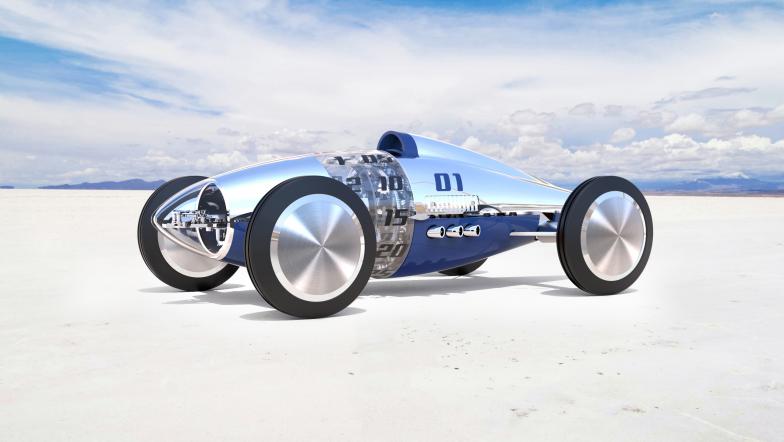
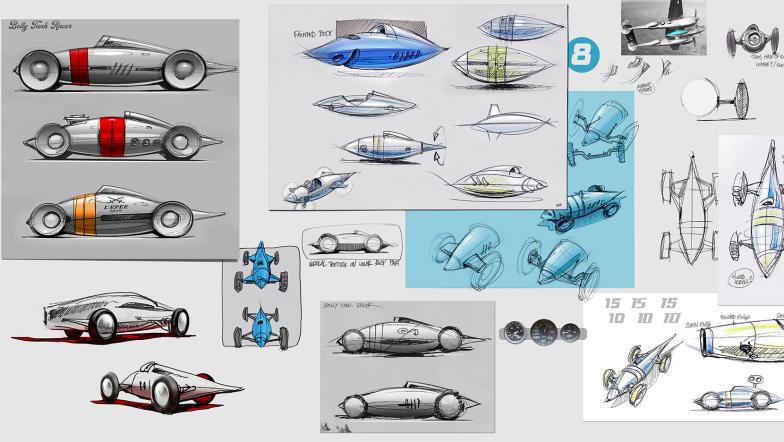
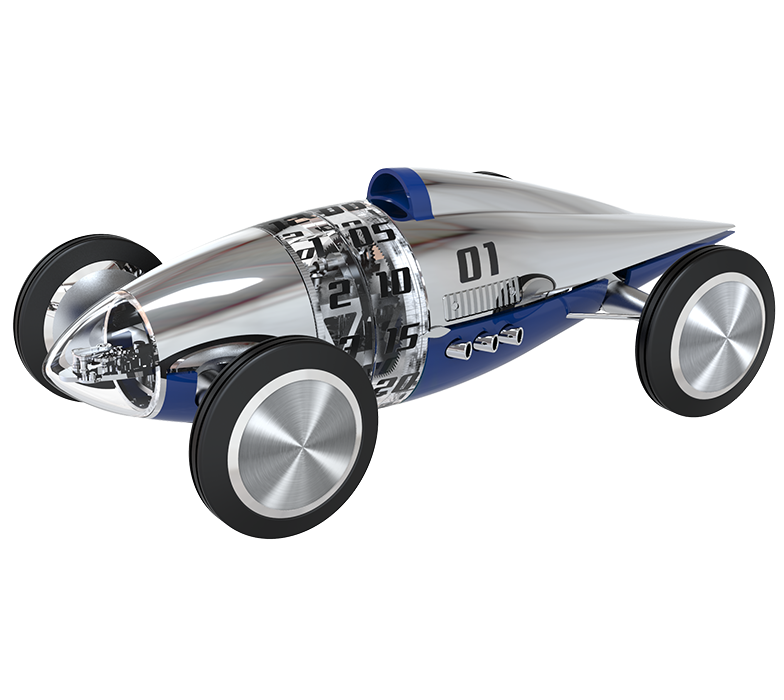
Designed by Eric Meyer, the belly tank racer is all about effortless sophistication—its pure lines and radical simplicity creating a presence that feels undeniably modern. Rooted in heritage yet shaped by a forward-looking vision, it stands as a timeless expression of refined motor design.
THE STORY
L’Epée 1839’s Belly Tank Racer captures the spirit of a golden age of ingenuity — an era defined by rebuilding and bold reinvention. Its elongated teardrop form recalls the unmistakable profile of the 1940s belly tank racers: low, narrow, and engineered with purpose. True to L’Epée 1839’s signature, every component serves a purpose, with form shaped by function — each detail designed counts.
More than record-setters, belly tank racers embodied optimism and reinvention — where determination, courage, and mechanical creativity transformed remnants into beautifully shaped icons of progress, a philosophy of ingenuity and mechanical creativity that remains at the heart of L’Epée 1839.
Both nostalgic and forward-looking, its clean lines and wind-shaped curves give it a sleek, contemporary presence. Even at rest, the silhouette feels ready for acceleration.
L’Epée 1839’s Belly Tank Racer bridges eras, blending the optimism and mechanical ingenuity of post-war American racing culture with modern almost futuristic aesthetics.
Within the streamlined form of the L’Epée 1839 Belly Tank Racer, the time display is seamlessly integrated into a smooth, aircraft-designed aerodynamic body, wrapping around the central cylinder like painted racing graphics and becoming part of the machine rather than a separate dial.
Hours and minutes are shown on two transparent rotating discs, allowing time to glide effortlessly across the visible mechanism beneath.
Every gear, every oscillation part of the Belly Tank's "mechanical engine" becomes a visual experience.
Any questions ?Contact us
INSIGHT
Originally designed for aircraft, these streamlined aluminum drop tanks were built to extend flying range. When empty, pilots would release them to reduce drag in flight and combat. After the war, thousands remained as military surplus — abundant, lightweight, and most importantly, perfectly aerodynamic. Former pilots and racers did no see waste, but rather a ready use innovative part.
In Southern California, racers gathered on the dry lake beds - places like Muroc and El Mirage - to test their machines in straight-line speed runs. These were the early days of land speed racing.
The goal was simple: Go as fast as possible in a straight line. Traditional hot rods were fast, but they weren’t streamlined. Belly tanks changed that.
Racers split the tank open, reinforced it, and squeezed inside - often lying almost flat. The driver sat low and tight, barely visible, making one with his machine.
The result was a tiny, torpedo-shaped car that sliced through the air. And they were fast.
Some early cars broke 150 mph, then 200 mph - astonishing speeds for backyard-built machines of the era.
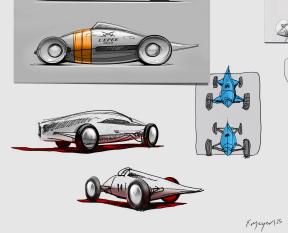
Design feels nostalgic yet distinctly modern thanks to its clean, minimalist lines
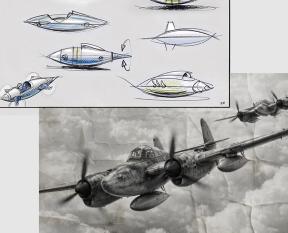
Pure aeronautics inspiration and reimagined for speed on the ground
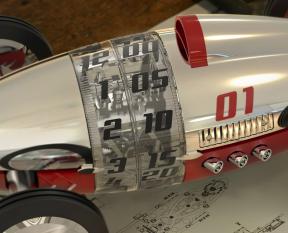
Time is displayed on transparent discs, while revealing the movement inside
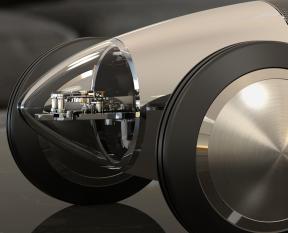
Escapement is located in the front
Technical Specifications
Limited of 99 pieces, available in five colors: Blue, Green, Metallic Grey, Red, and Black.
Dimensions
Length: 420 mm / Width: 212 mm / Height: 123 mm / Weight: 5.4 kg
Functions
Hours and minutes displayed on two transparent rotating discs.
Time is set by rotating the minute disc clockwise by hand (upwards).
The clock is wound using the rear wheels.
Rolling the piece backwards (rotating the rear wheels) winds the movement, like a pullback car.
The piece moves freely forward
Engine / Movement
L’Epée 1839 movement, developed and manufactured in-house.
Frequency: 2.5 Hz / 18,000 vibrations per hour.
Jewels: 11
Power reserve: 8 days
Incabloc shock-protection system.
Body & Wheels
Upper and lower body crafted in aluminum.
Steel rims.
Soft rubber tires
Materials & Finishes
Materials: Palladium-plated brass, polished stainless steel, acrylic glass for the cylinders and dome.
Finishes: Polished, satin-finished, and sandblasted movement; polished and satin-finished rims; lacquered bodywork.

Reference
Red
Limited edition of 99 pieces
Inquire
30'955 CHF / excl. VAT

Reference
Black
Limited edition of 99 pieces
Inquire
30'955 CHF / excl. VAT

Reference
Green
Limited edition of 99 pieces
Inquire
30'955 CHF / excl. VAT
Reference
Blue
Limited edition of 99 pieces
Inquire
30'955 CHF / excl. VAT

Reference
Grey
Limited edition of 99 pieces
Inquire
30'955 CHF / excl. VAT